AI That Understands
Insurance
From claims transcripts and adjuster notes to emails and documents — discover how leading insurers are turning unstructured data into competitive intelligence across underwriting, fraud, customer experience, and beyond.

Underwriting Intelligence
"42% of homeowner claims in ZIP 30339 involve roof repairs from 3 specific contractors"
Underwriting Intelligence leverages AI to analyze vast volumes of claims data, contractor records, geographic patterns, and historical loss information to surface hidden risk signals that human underwriters may miss. By processing unstructured data from call transcripts, adjuster notes, and inspection reports, insurers gain a granular view of risk concentration across regions, contractors, and property types. This enables smarter pricing decisions, tighter risk selection, and proactive portfolio management. AI-driven underwriting reduces adverse selection, improves loss ratios, and empowers underwriters to act on data-backed insights rather than intuition alone, transforming underwriting from a reactive function into a competitive advantage.
Autonomous Claim Adjuster - AI Voice Agent
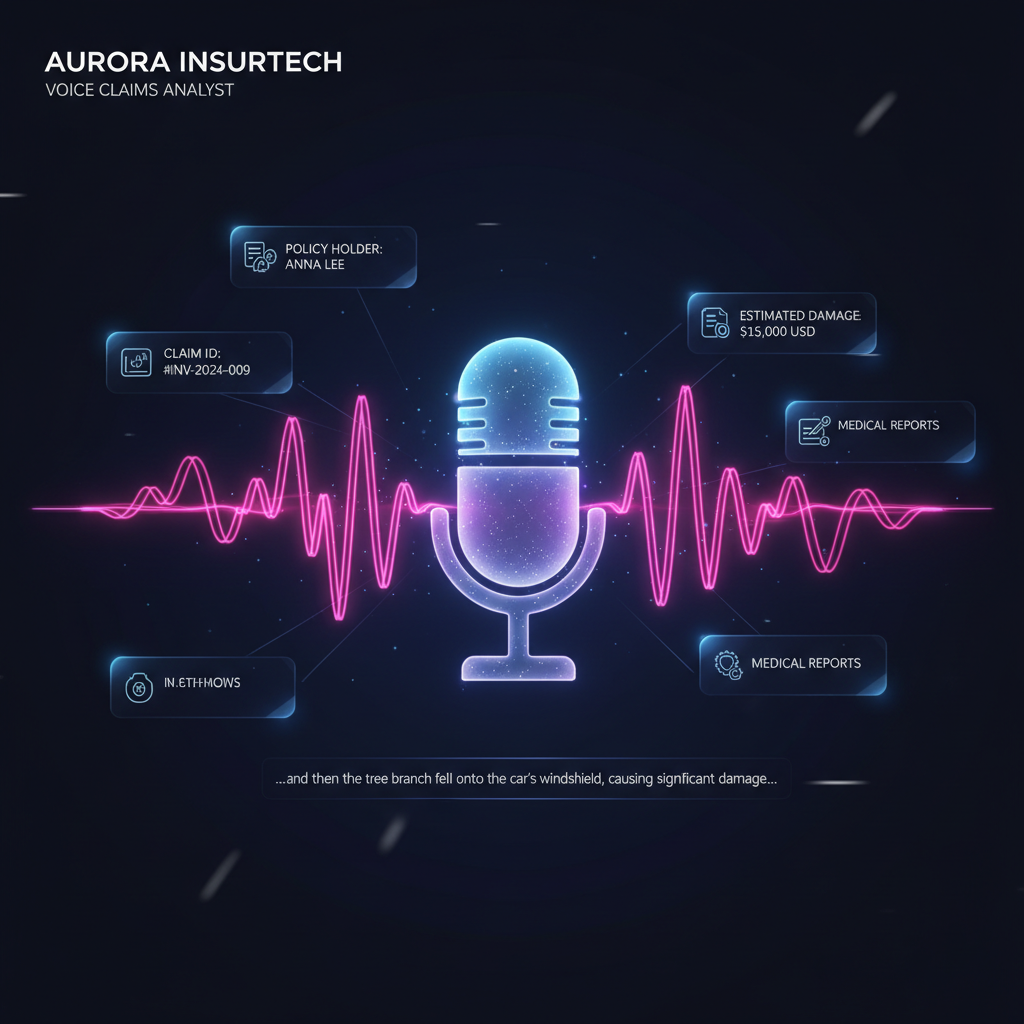
"Conducts recorded statements autonomously — dynamically adapting questions based on claimant responses in real time"
The Autonomous Claim Adjuster Agent replaces manual recorded statement interviews with an AI-powered voice agent that conducts structured claimant conversations end-to-end — no human adjuster required. The agent dynamically adapts its questioning based on each claimant's responses, probing deeper where needed and following the most relevant lines of inquiry for that specific claim. In real time, it builds a fully structured claim file, automatically extracting and tagging entities such as dates, locations, involved parties, damages, injuries, and witnesses. Throughout the conversation, the agent simultaneously detects fraud signals, litigation risk indicators, and claimant sentiment shifts — enabling immediate SIU referrals or supervisory escalation before the call concludes. The result is faster claims intake, consistent documentation quality, and earlier risk identification at a fraction of the adjuster time.

Legal & Litigation Prevention
"'I think', 'maybe', 'not sure' phrases → higher litigation probability"
Legal and Litigation Prevention AI monitors claims conversations and written communications for linguistic signals that correlate with elevated litigation risk. When adjusters use uncertain or uncommitted language — such as "I think," "maybe," or "not sure" — during claim discussions, AI flags these interactions for supervisory review before a dispute escalates. Early detection allows claims managers to intervene, clarify coverage positions, escalate to senior adjusters, or initiate proactive settlement discussions. This capability reduces legal spend, shortens the claims cycle, and protects insurers from unnecessary litigation costs that arise from miscommunication, ambiguous commitments, or delayed resolution of contested claims.

Cross-Channel Intelligence
"Customer said X on call, but emailed Y later → inconsistency detected"
Cross-Channel Intelligence unifies data from phone calls, emails, chat logs, web portals, and agent notes to create a complete, consistent view of each claimant's communication history. AI automatically detects when a customer's statements across channels are inconsistent — flagging cases where what was said on a call contradicts what was written in an email or submitted in a form. These inconsistencies are critical signals for claims investigations, SIU referrals, and coverage dispute resolution. By breaking down communication silos, insurers reduce fraud exposure, improve claims accuracy, and ensure that every team member — from the call center to the back office — operates from the same verified record.

Fraud & Network Intelligence
"Same accident narrative reused across 9 claims with slight variations"
Fraud and Network Intelligence applies AI to detect coordinated fraud schemes that are invisible to traditional rule-based systems. By analyzing the language, structure, and metadata of claims narratives across thousands of submissions, AI identifies when similar accident descriptions, injury patterns, or provider referral chains appear across multiple unrelated claims — a hallmark of organized fraud rings. Network analysis maps relationships between claimants, attorneys, medical providers, and repair shops to expose collusion. Early fraud detection reduces claim payouts, protects honest policyholders from subsidizing fraud through higher premiums, and enables Special Investigations Units (SIU) to prioritize the highest-risk referrals with evidence-backed intelligence.
Ready to Transform Your Insurance Operations?
Let's discuss how AI can unlock intelligence from your claims, calls, and documents.
Book your Demo